
Sense of Caste as Sense of Ritual
Ritualization in Thirayattam
Keywords:
Thirayattam , ritualization, caste, Dalit ritual practices, sacred space , ritual environment, embodimentAbstract
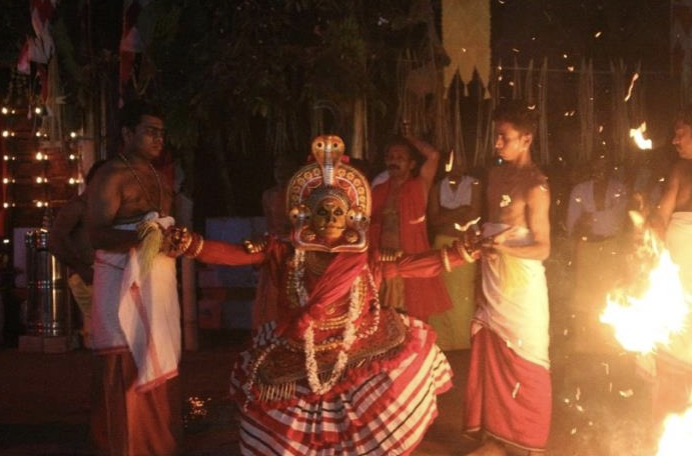
The paper explores the interplay of performance and caste in the ritual festival of Thirayattam in Kerala in South India. This day-long festival features the performances of Thirayattam, in which Dalit (“lower caste”), performers transform and dance as deities in a state of possession trance. In events of the festival, there is ritual action that signal inversion of caste and elevation of status of the Dalit performer. This paper looks at the process of ritualization in Thirayattam, with framework of ritual as practice propounded by Catherine Bell. It takes a close look at the production of ritual environment through strategic action of participants of the ritual complex. The paper studies specific ritual activities to argue that interaction of ritual participants with the space structures the ritual environment in Thirayattam as sacred, pure and hierarchical. The paper argues that the strategic action involved in ritualization builds an implicit disposition of caste-affirmation.
References
Ambedkar, B. R. Annihilation of Caste: The Annotated Critical Edition. Edited by S. Anand.
Introduction by Arundhati Roy. Navayana, 2014.
Azhikode, Sanjeevan. Theyyathile Jaativazhakam. Current Books, 2007.
Babb, Lawrence A. “The Food of the Gods in Chhattisgarh: Some Structural Features of Hindu
Ritual.” Southwestern Journal of Anthropology 26, no. 3 (1970): 287–304.
Bell, Catherine. Ritual Theory, Ritual Practice. Oxford University Press, 2009.
Bhattathiri, et al. Malayalam–English Dictionary. DC Books, 2017.
Bourdieu, Pierre. Outline of a Theory of Practice. Translated by Richard Nice. Cambridge University
Press, 2013.
Chandran, T. V. Ritual as Ideology: Text and Context in Teyyam. Indira Gandhi National Centre for
the Arts and D.K. Printworld, 2006.
Douglas, Mary. Purity and Danger: An Analysis of the Concepts of Pollution and Taboo. Routledge, 1984.
Dumont, Louis. Homo Hierarchicus: The Caste System and Its Implications. Translated by Mark
Sainsbury, Louis Dumont, and Basia Gulati. Oxford University Press, 1999.
Gluckman, Max. Order and Rebellion in Tribal Africa. Cohen & West, 1963.
Joshi, Deepa, and Ben Fawcett. “Water, Hindu Mythology and an Unequal Social Order in
India.” Paper presented at the Second Conference of the International Water History
Association, Bergen, Norway, 2001.
Lehmann, Hans-Thies. Postdramatic Theatre. Translated by Karen Jürs-Munby. Routledge, 2006.
Natarajan, T. “Social Stratification, Temple Entry Movements and Consequent Constitutional Reforms in Madras Presidency (1919–1947).” PhD diss., 1996. Shodhganga. Accessed December
, 2022. https://shodhganga.inflibnet.ac.in:8443/jspui/handle/10603/92147.
Peethambaran, M. Thirayattam. Kerala Bhasha Institute, 2017.
Rajkumar, Peniel. Dalit Theology and Dalit Liberation: Problems, Paradigms and Possibilities. Ashgate,
Reese-Taylor, Kathryn. “Sacred Places and Sacred Landscapes.” In The Oxford Handbook of
Mesoamerican Archaeology, edited by Deborah L. Nichols and Christopher A. Pool, 752–63.
Oxford University Press, 2012.
Schechner, Richard. Performance Studies: An Introduction. Routledge, 2013.
Schechner, Richard. Performance Theory. Routledge, 2003.
Turner, Victor. The Anthropology of Performance. PAJ Publications, 1988.
Turner, Victor. From Ritual to Theatre: The Human Seriousness of Play. PAJ Publications, 1992.
Downloads
Published
Issue
Section
License
The copyright belongs to the authors and PRS.